Showing posts with label MUMTU. Show all posts

5.15.2011

Challenge Socks #6: Mermaid With Golden Hair

I can't believe it's May, let alone mid May!!! April practically flew by, with C's big birthday party, a lovely and long visit from my mother-in-law, the start of a wonderful new job, and more bouts of viruses running through the family than we ever imagined possible in a mere thirty days! May, too, is flying, with Mother's Day last Sunday, my birthday last Monday, and J's birthday today. These are busy, busy times! And in case you were wondering about whether I was still making progress on My So-Called Sock Challenge, I do have something to show for my long-finished March efforts:


I call them Mermaid With Golden Hair because the first line of "Mermaid Song" from Andrew Lloyd-Webber's Aspects of Love ran through my head practically the entire time I knit them. I can't remember the last time I even thought about that musical -- maybe a decade ago?

With these socks, the story is all about the yarn. Oh... My... Goodness! I can't say enough about how I love it!

It's Lollipop Cabin's organic, single-ply sock yarn, from right here in the Pacific Northwest. From their own PR: "Organic Wool Sock Yarn, individually hand-dyed using rain water collected from a wee little cabin located in the Pacific Northwest Cascade Mountains." 

Quaint, no?! Makes me want to go cuddle up with my knitting in that wee little cabin and listen to the rhythm of the rain beating on what I imagine to be a perfectly musical little tin roof before it tumbles into a rain barrel to be collected for dyeing!

I stumbled upon this yarn back in January, when my Mom was visiting. We spent a few days driving around to yarn stores, hitting not only our old favorites but also spreading out to catch some we'd never been to before.

The biggest score happened January 7 at Country Yarn in Snohomish. The shop doesn't have a website, but here's a link to the basic business info. Country Yarn is a real treat for the spinner, as well as the knitter, with a more extensive spinning selection than I've seen locally anywhere but at The Weaving Works -- and certainly a larger and more interesting selection of hand-dyed spinning fibers!

Among other things, I picked up enough Lollipop Cabin yarn for two pairs of socks (the other will be in lovely peaches), and my Mom picked up enough for a pair, herself.

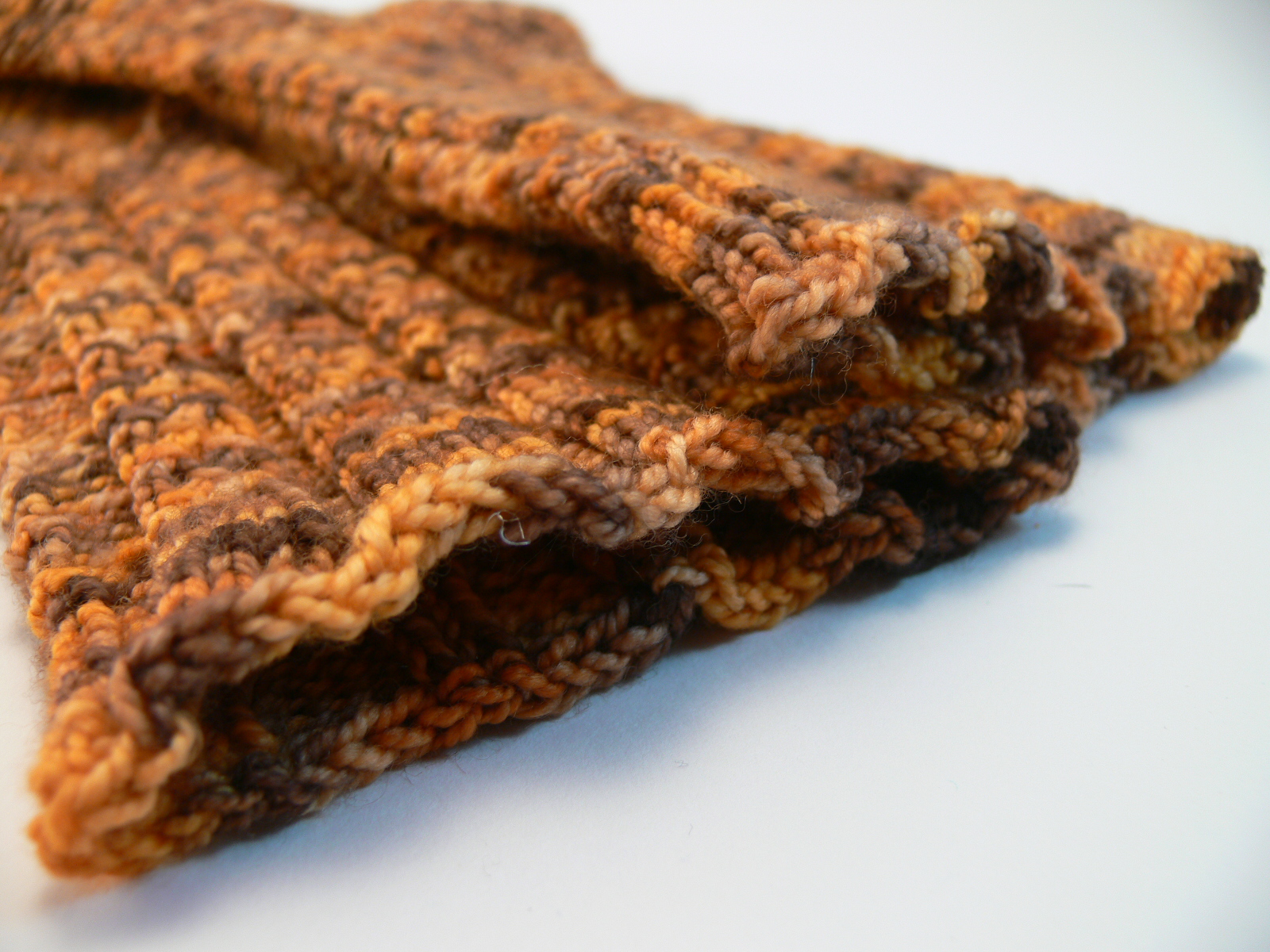
You can get a visual inkling of just how cushiony, springy, densely wonderful this yarn is by looking at the bind-off edge of my socks. See how nice and round and tall the edge stands up? That's all the yarn's doing -- no photo styling!


Compare to the pursed-lip bind-off edge on the Jealous Zigzag socks my sister sent me last month (Brown Sheep Lamb's Pride Superwash) -- which are still getting heavy wear in my sock rotation -- or the similarly flat Fascine-ation socks (Koigu PPM) finished in February -- these socks are positively bursting with body!

Plus they are soft, soft, soft. And as I knit, I enjoyed the slight stretch sensation. A thoroughly enjoyable knitting experience!

Be forewarned if you're a fan of the highly processed: you will encounter little bits of VM in your Lollipop Cabin yarn. No biggie. It's not enough to be a nuisance. Just pick it off as you go.

The angle of this picture really highlights the golden tones:


I love this stitch pattern. You've seen it before on Aesthetic Entanglementz with my Pink Pagewood socks back in December 2008. It's a simple, 1-row, twisted knit rib worked over a multiple of 6 stitches, and I know you'll love it, too, so here it is:

Twisted Rib: K3, P1, K1tbl, P1

You'll notice that although it's made up of a completely symmetrical stitch pattern, the rib looks asymmetrical in the fabric. This is because the twist effectively nudges its stitch to the left a bit. I think it elevates the interest of the humble rib to a greater sophistication. It works equally nicely in a sleek trouser sock or a thick jeans sock. And if you're not a fan of swatching, you don't need to swatch the rib separately from stockinette to be assured of fit!

As you know, I never tire of the Eye of Partridge stitch on my heels. It's so pretty, and the stitch feels even in the back of my socks rather than ridged, like you get with the slipped rib stitch.


I realized in putting this blog together, though, that my sister and I do our heels slightly differently -- even though she also uses my MUMTU pattern. Here's the link to a picture of the heels she put on my Jealous Zigzag socks. Can you tell what's different?

That's right: I put Eye of Partridge on the heel extension (that little triangle-shaped area on the bottom), in addition to the heel flap; she doesn't. There's no right or wrong here -- it's just an example of how people develop their individual ways of doing things. She wears her hand-knit socks every bit as often and hard as I wear mine, and as far as I know she's never had to darn a heel, either. 

One last thing about the Lollipop Cabin. Our County Yarn shopkeeper, who knows the dyer, said this yarn is guaranteed not too pool. You can be sure my ears perked up at that! Now, I am realistic. I know that pooling in socks is as much a factor of gauge and stitch count as it is of some property inherent in the dye work (although I also think hand-dyers can do a better job mathematically predicting probable round-repeats so as to avoid the most unsightly pooling for the majority of sock knitters). I know that some pooling is bound to creep in. I just hope that it's not obnoxious. How did Lolllipop Cabin do?


Pretty darned well! The patterning remains even -- without being icky-stripy -- in all but one area: the gusset. That's the only spot of pooling ... and it's not surprising that the color would sit differently in this area since it's where stitches get increased.

So a big thumbs-up to Lollipop Cabin!

Best of all, I think there's enough yarn left to make a follow-up pair for C, my own little mermaid with golden hair. She'll be thrilled!

My So-Called Sock Challenge Tally (through 4.14.11):

Total: 6 pairs in 4 months

The Details:

Pattern: Mash-Up Magic Toe-Up Socks (designed by me)
Started: March 1, 2011
Completed: April 14, 2011
Materials: Lollipop Cabin Softsock, 2 240-yard skeins, colorway 1804i
Needles: US 2 / 2.75 mm
Gauge: 7.5 st/in
Primary Stitch Count: 60


4.19.2011

Another Good Turn

Remember the Marshlands Lace Rib socks I knit, intending them for myself but realizing after they were done that they were better suited to my sister? I shipped them off to her in New Orleans, and despite the fact that temperatures there were on the verge of rocketing out of the comfort range for closed-toe shoes and wool socks, she's gotten some good wear out of them.  

In a funny twist of fate, she found herself in a similar situation. This time it was me who lucked out because these beauties


arrived in my mailbox as a result!

On April 2, as she had just finished the toes of her April challenge socks, Beth called me to talk about my toe-up adaptation of Cookie A's Monkey pattern, which she intended to use. You'll note from the picture that these are not Monkey socks. We talked about the decorative stitch and the particular qualities of her yarn for awhile, and she decided to switch to the decorative stitch used by Christine Walker in her Zigzag socks (published in Vogue Knitting: The Ultimate Sock Book). It's a lovely pattern -- wonderful stitch movement but very light, without the usual density of cables.

Three days later I received the following text:
"I'll be sending u the socks I'm making now. Seem too small for me. Funny. The yarn is better suited for u anyway."
And she's right. The yarn is better suited for me. What's funny is that I never would have selected it myself if I were treasure hunting at the yarn store, but the finished socks undeniably look more like something I would wear than she would. 


It's a Brown Sheep Lamb's Pride Superwash in sport weight.  The colorway, SWS162 Green Envy, inspired her to name the socks Jealous Zigzag -- which I love! (Before I knew the name of the colorway, I thought she called them that because she was jealous they ended up being more right for me than for her -- which is, admittedly, how I felt about sending off the Marshlands.)


You'd think that a yarn called Green Envy would be more . . . green. This yarn is a mix of very pale green and very pale lavender -- and the effect, overall, in the finished socks is silvery. But it's not flat color. It's very, very cool.

She worked the entire day after sending that text. And just five days after casting on had the socks off the needles and blocked. What's more, she had them in the mail the next day! I don't know about you, but it can take me weeks to package up an item and actually deliver it to the post office. She'll deny being an over-achiever, but I can't think of what else to call it! 

Best of all, these are the mushiest, softest, most deliciously wearable socks. They spent the entire last weekend on my feet. I have declared them the best jeans socks ever. Honest to goodness!


And having shared my adoration of them with Beth, I'm pretty sure she actually is jealous now.

I need to reevaluate my sock yarn purchasing choices. Left to my own devices, I wouldn't have had a clue how wonderful this Brown Sheep yarn is.

Ravelers can link to the project page here.

3.06.2011

Challenge Socks #4: Sleeping Socks For C, No. 2

When last we met the fourth installment of My So-Called Sock Challenge (a.k.a. Sleeping Socks for C, No. 2), I was second-guessing my yarn choice. As you may recall, I'd completed the toes before I realized that I was working with a thick-thin yarn that might not be sock-comfy.

On the advice of Shannon and some of my off-line knit compadres, I stopped second-guessing myself and just plain went for it. A mere four days from start to finish, my fourth challenge socks -- made to fit a child size 4 (that's 8 inches long and only an inch shorter than my own size) -- came screaming off the needles:


I had decided to call the handspun, of which I had just shy of 185 yards, Poisoned Apple as a nod to the fact that this project had seemed like it would be such a simple, quick, no-brainer but then I was zapped -- surprised by the reminder that I'd used this yarn to experiment with inconsistent grist. The other thing about this yarn is that I don't have a clue whether the wool is superwash or not. I'd purchased the roving from A New Yarn shortly before the shop went out of business, and it had come in as a donation with no label.

Of course, once I got past my hesitation of whether to continue using the Poisoned Apple handspun for sock, they really were a speedy knit. I didn't analyze yarn weight, but it's probably somewhere between Aran and worsted in the thick areas and between fingering and DK in the thin ones.


I stuck with simple stockinette and let the handspun do its thing. Ironically, the major color shift happened the same place on both socks. The yellow and dark green variations all landed in the space from the toe to the heel, and the brighter greens landed from the heel to the cuff. They're fraternal yet matched in an interesting way.

You may have noticed already that I veered from my standard sock preferences and put in a short-row heel rather than my favored turned heel with gusset.


What persuaded me to do such a thing?!

A reality check: These socks are meant for sleeping in; they're not being worn inside shoes or even on a person who will be upright much of the time they're on. Moreover, I had no intention of spending a lot of time on these socks -- especially considering that fact that if they aren't superwash, they might not have been the best choice for a sleep sock -- and short-row heels knit up more quickly than the heel-flap/gusset variety. The double-wrapped diagonal line is super thick in some places, but it did work quite nicely.

Finished off with a simple 2 x 2 rib cuff at ankle length, they now make a nightly appearance on the Girlio's feet.

Thanks to everyone who encouraged me to soldier on!

Pattern: Mash-Up Magic Toe-Up Socks (designed by Zhenya Lavy)
Materials: Poisoned Apple Thick-Thin Handspun, 183 yds, spun at my Mom's house in Ohio
Skein 1, 93 yds, spun and plied on my sister's Ashford Traditional, 1/27-28/10
Skein 2, 90 yds, spun on my sister's wheel and plied on my Spencer Parasol dropspindle, 1/29/10
Needles: US 4 / 3.5 mm
Gauge: 5 st/in
Primary Stitch Count: 36
Started: February 2, 2011
Completed: February 5, 2011

3.01.2011

Challenge Socks #3: Fascine-ation

I can't tell you exactly why it took me so long to post these socks; I can tell you that I absolutely adore them! I completed them exactly one month ago today and call them my Fascine-ation socks. A pattern is forthcoming.

The decorative stitch on these socks is quite wonderful. From a distance, it looks like a cabled braid:


But take a closer look and you discover that there's no cabling involved whatsoever!


The diagonal lines that your eye reads as crossed stitches have been created using the simple technique of slipping stitches that then get passed over newly knit stitches. It's ingenious, quick to work, and easy to execute without those pesky errors that creep in with some stitches just because you can't quite remember -- or figure out -- what row you're on.

To be clear, I'm not the clever knitter responsible for developing the Fascine stitch. As with so many other wonderful stitches, we have Barbara Walker to thank for bringing it to our attention. I think it's an absolutely perfect stitch to try with hand-dyed yarns that don't have long color repeats. The diagonal slip/passover breaks color lines and enhances the visual interest without overpowering the dyer's work.

The Fascine stitch's comparison to cables doesn't stop at resemblance. The stitch draws the fabric of the sock in for a nice, dense, foot-hugging fit. They're so comfortable that they may just be my favorite hand-knit socks to-date!


The basic sock construction follows the MUMTU recipe.  The decorative stitch begins on the top of the foot and extends up the leg for a long, lean look. As is my usual preference, I worked a traditional, turned heel with the Eye of Partridge on the heel flap.

I used Koigu PPM in browns and couldn't be happier with the results. This particular yarn is one of Koigu's more subtle in the nuances of its colorwork, with some areas containing delicate speckling that leaves me puzzled as to the dye technique. Whenever I buy Koigu, I look for colorways with this quality -- as far as I'm concerned, there is no more wonderful dye work done today.  (My Monkey socks were knit from a similarly scrumptious Koigu.) My only disappointment with this yarn was that there were two knots in one of the skeins. I'd not experienced that with Koigu before and was surprised to find the first, let alone a second.

After a 3/4-inch rib, I finished with Jenny's Surprisingly Stretchy Bind-Off:


In this application, the bind-off created an almost ruffled edge. This is because the bind-off's expansiveness gets doubly emphasized by the Fascine stitch's denseness. I imagine the bind-off would have the same impact coming off a cable. The ruffle disappears during wearing, though, so it's not something that could work as a design element.

Specs:

Pattern: Mash-Up Magic Toe-Up Socks (MUMTUS) by Zhenya Lavy
Decorative Stitch: Fascine Stitch worked over a 6-stitch repeat
Materials: Koigu PPM browns with a hint of orange
Needles: US 2 / 2.75mm
Gauge in Stockinette: 7.5 st/in
Primary Stitch Count: 60
Started: January 19, 2011
Finished: February 1, 2011

2.09.2011

Goal!

Early last spring, just before things got crazy with my job and the move, I achieved a milestone: I spun singles that were both fine enough and consistent enough for me to ply into a viable, fingerweight sock yarn! The fact that I'm only just now writing about it should be some indication of just how fantastically life intervened.

The story:

When my Aunt Mae died late last January, I flew back to Ohio, and my sister and mom (who still lives in Ohio but had been visiting my sister) drove up from New Orleans. They picked me up at the Cleveland airport on their way into town. No sooner had we finished our hugs than we started plotting which yarn stores we could hit on the way to Mom's house. Mind you, Beth had been driving for 20 solid hours, proving two things: our compulsion for fiber borders on the masochistic and, apparently, is also genetic.

We landed at KNOTS (Knitting on the Square) in Chardon, the quaint little town where my husband grew up which is, conveniently, just a 20-minute drive south of my mom's current home. At KNOTS we chatted with the wonderful owner, Kate Jackson, and found so many great things. We were surprised to find spinning fiber at all, let alone her healthy stock of indie-dyed beauties. Kate was flabbergasted that we went straight to her shop before even getting to our destination! We picked up several kinds of fibers and colorways. More on my purchase in the future -- the subject of today's post is this lovely:

Dancing Feet Roving by TomBoy Yarns.
4oz or superwash Blue Faced Leicester.
Colorway: Jewel Tones.

They may be common colors, but they spoke to me that day... and the BFL was just so luscious.

Jump forward to April. Joseph and I had just signed a contract to purchase our new home. With the pressure to pack and move within six weeks crushing down upon me, I made what seemed then to be a logical choice: I spun the entire 4 ounces on April 5 and Navajo/chain plied it the next day. The whole time, I was thinking, "This could be socks," and behold:

380 yards. Sock yarn!

I cast on and madly knit the toes, foot, and gusset before I had to get serious about moving.

Flash forward to November. With four glorious months of parental leave stretching out before me, sanity and space returned and I found my creative energy restored. Out came the socks!


Pattern: Mash-Up Magic Toe-Up Socks (MUMTUS) by Zhenya Lavy (workshop pictorial, Ravelry page, downloadable PDF of the condensed pattern)
Primary Stitch Count: 52
Started: April 28, 2010
Completed: November 28, 2010
Materials: My Navajo-plied handspun from Superwash BFL, Jewel Tones (Dancing Feet Roving by TomBoy Yarns)
Needles: US 2 / 3.00 mm

I used a mock cable stitch with alternating twists for the leg:


This Mock Cable has a simple, four-row repeat:

1: *MT, P2, K2, P2* repeat
2 & 4: K2, P2
3: K2, P2, *MT, P2, K2, P2* repeat

(MT = Make Twist. K2tog but don't slip off needle. Insert needle back into the 1st stitch and knit. Slip both off needle.)

Blocked 

My handspun was a joy to knit. I found myself stopping to admire my work much more frequently than usual!

I have 26 grams of the handspun left -- that's about 23% of my starting quantity. I only used 77% of my fiber... about 266 yards. This confuses me. The yarn looks and feels like fingerweight, but it knit up like a higher grist. Hmmm... Thoughts?

Doesn't the color flow beautifully through the fabric? I didn't do any special spinning techniques to manipulate the color. I just let things fall where they may in the spinning and Navajo plying processes.

Before blocking. Squishy and luxurious!

They're definitely a fraternal pair, which would drive my sister crazy, but I'm good with it!  It's most obvious here:


I know it's generally preferable to block before photographing, but sometimes I feel like the blocking renders a "sterile" picture. In their pre-blocked state, they shine with all the charisma of the kinesthetic experience they have to offer!


When all was said and done, they didn't take all that much touch time to spin and knit... but they ended up being a seven-month project. Yikes!


Sadly, last week Kate announced that she's selling KNOTS to spend more time with her two little ones and prepare for the arrival of a third. Congratulations, Kate! I've really appreciated your approach and your fun voice in the newsletters. 

I'm praying someone wonderful buys the shop. As my mother-in-law says, "It's such a nice addition to Chardon Square." As I see it, a yarn store is perfect for a serene, historical setting. I'd be all over it if we still lived in Ohio!

12.30.2010

In Praise Of Her Triumph

This sock,

To you and I, perhaps, a simple exercise,

To her, a labour of love. My mother's right hand, once dominant, now dormant

In its new place -- even now nearly 18 years since the aneurysm and strokes -- as second to the left.

Time once was she lulled me to sleep with quicksilver clicking and sliding of needles, yarn dancing in her hands.

Gifts for herself and others all but flew from her tips.

Today, each stitch a miracle of patience and perseverance.

The woman who dared once more to live, to walk, to speak, to drive, to fight for independence...

The woman who dared not dream of gardening, of grandchildren, of quilting, of knitting...

All these, now, she enjoys,

And with her we celebrate.

We praise her triumph daily.

How could we have predicted the extraordinary work she would do to retrain her left hand, befriend that sinister side, as she determined to knit again, one-handed, nearly fifteen years after the insult? Then on from dishcloth to scarf to sock, and not one but two at a time?

Hers is a simple faith and patience

That each stitch can be made, each technique mastered,

In its time.

Which is saying a lot.

For her time moves more slowly now,

And socks that once would have been the whim of a week now occupy the steady ticking of a year.

But oh, what a glorious year:


Each stitch, each day, a blessing without equal!


Pattern: Mash-Up Magic Toe-Up Socks (MUMTUs) by Zhenya Lavy. Ravelers get it here. Or find it with a full pictorial on Aesthetic Entanglementz.
Modified for a short-row heel.
Started: January 1, 2010, on Orcas Island in the San Juans (WA)
Progress: New Orleans (LA) and Mentor (OH)
Completed: December 17, 2010, in Lake Forest Park (WA)
Materials: Crystal Palace Yarns' Mini Moochi, Green/Purple 103, 2 skeins
Needles: US 2 (40" circular)

11.25.2010

Special Black Friday Fiber Prices at OFA

Happy Thanksgiving, everyone!

Check out the latest inventory update at Olympic Fiber Arts, with seven new hand-dyed spinning fibers posted. All are 100% superwash wool, suitable for next-to-the-skin wear and great for socks! If you haven't checked out the new line, now's your chance. For the Black Friday sale, all hand-dyed spinning fiber has been marked down 25% through 11pm on December 3.

New Growth, 100% superwash wool in fresh greens with a hint of pink


Many longtime favorite yarns have made their way to the Clearance section, where they've gotten their final markdown to 60% off or more.

I've been working to finish knitting a pair of socks that I'm making from my own hand-spun wool. Pictures to come in the next post.


Best wishes for sugarplum dreams and fantastic Black Friday bargain finds!

3.20.2010

Island Knitting


My family went to Orcas Island in the San Juans the first week of January. I love the island at this time of year. We took my mother with us to the little two-room cabin on the waterfront that has become our favorite home away from home. The last night of our stay, the setting sun reflected gorgeously on the underside of the clouds. It was truly stunning.

I knit a pair of socks on the trip.


Pattern: Mash-Up Magic Toe-Up Socks (MUMTUS) - recipe compiled by me
Materials: Cherry Tree Hill's Supersock DK, Colorway: Country Garden, 1 skein
Needles: US 3 / 3.25 mm
Gauge: 6.5 st/in
Primary Stitch Count: 52


It's a straightforward sock: stockinette on foot and gusset, eye of partridge on the heel, standard 2x2 rib on the cuff. I finished them within the week of our trip.

This is the first time I've done a DK weight sock for myself. They're mushier and thicker than my usual preference. CTH promises that they wear like iron, and I'm putting it to the test given my preference for wearing boots every day. I have to say, the stretchiness of the fabric, even though I used a smaller needle size than recommended, causes me pause. Every time I put them on and slip them into my boots, I think, "Today's the day my toe will go through the end!" So far so good, though. No holes. I did reinforce the toes with my standby Russian laceweight wool, and it's only been about two months. Still, they're getting heavy wear in steady rotation...

I started another pair of socks on the island, too. This with Noro's Kureyon sock yarn. I'll blog on those later, but suffice it to say for now that I have not enjoyed one, single stitch on these socks, evidenced by the fact that they've been on the needles for two months and I've yet to get halfway through the gusset. If anyone out there has insight into the appeal this yarn holds for people, please share!

12.21.2008

Many Happy Returns

Oh, my—it's been two months since I posted! We can mark the beginning of my long silence to my return to full-time work, which has been quite an adjustment after a couple years' dissertation writing. (This is not to say that the dissertation is finished, just to say that it's no longer my full-time focus—which underlines the extremity of my lack of blog time.) I have continued to knit, though, plus I taught two classes and have developed another original design for one of the classes I will teach this winter.


I thought it would be nice to mark my return to blogging with a return to the Pagewood MUMTU socks I made in conjunction with the sock class I taught over three sessions in October. When last I wrote, I was thoroughly enamored with the Pagewood Farm Denali Hand Dyed Sock Yarn. Seriously enamored with it... just look at the subtle sophistication of the gorgeous Butterfly colorway!

When I returned home from the final class—where I had let two of the students practice Elizabeth Zimmerman's stretchy cast-off on my socks because they hadn't quite finished the cuffs on their own—I couldn't wait to pop them straight in the Eucalan.


If you haven't tried this soak for your woolens, I highly recommend it. I just swish a few drops into my favorite mixing bowl (which also happens to be the perfect size for soaking hand-knits), drop the socks in, let them sit for about 15 minutes, pull them out, and block/dry them. No rinsing required—it's great!


I love the way the reinforced Eye of Partridge heel looks. If you scan the above picture up to the cuffs, you can see how pretty the twisted rib looks in this yarn and how nicely it harmonizes with the heel stitch. And the yarn continues to woo me with its squishy goodness.

Some of the ladies in my class said they would not reinforce their toes or heels again because they thought it made the fabric too stiff. This was before they actually finished their socks. So I brought in several pairs with reinforced toes and heels as a demonstration: Even though it may seem like you've crafted your socks in Teflon while you're knitting, the yarns full together during washing and soften so much that you never notice the reinforcing thread when you wear them. (But they still wear like iron!)

As for this particular finished pair... and the wearing...


The socks are very pretty. As predicted, nobody else notices that they're two different colors, which I pointed out in my previous post. I'm not sure I'll knit another pair for myself in this Pagewood yarn, though. My reason has less to do with appearance than wear. These socks may actually be a little too soft. That sounds whiny and way over-privileged, so hear me out:

Remember how surprised I was that my primary stitch count was 60 for these, when I normally use 64 PSC for MUMTUs on fingering weight yarn? Well, the resulting fabric is much less dense than I prefer:you don't get the same stable feel from the fabric. And this means that while the socks are still thick and cushy feeling when I hold them in my hands, the fabric shifts and stretches so much when I put them on my feet (and into my shoes) that I worry they won't wear well over time.

Finally, they're a little thicker inside my shoes than I usually need in Seattle. If I still lived in Ohio's snow belt, they'd be much more necessary. But for Seattle's usually milder climate—I say "usually" because I've been snow-bound at home four days thanks to two storms that dumped more than 5 inches in my yard and frosted our hilly streets with a thick sheet of ice, making them completely impassable given our lack of municipal infrastructure for snow removal—for Seattle's usually milder climate, the socks aren't all that comfortable.

10.22.2008

Thoughts on Socks, Hand-Dyed Yarn, Colorways, and Better Labeling

I'm two-thirds of the way into another sock class I'm teaching at A New Yarn. We're using my MUMTU pattern to teach Magic-Loop technique, working two socks at once, toe-up, and using a gusset heel. You're already well-familiar with my pattern (download here) and in-depth pictorial workshop, so I thought I'd share my response to the sock yarn I selected this time around, as well as some thoughts about hand-dyed yarn and yarn labeling, in general.


It's Pagewood Farm's hand-dyed sock yarn in the Butterfly colorway. This is their Denali line, with a fiber content of 80/20 Superwash Merino and Nylon.

I'm particularly drawn to this yarn's lovely sensitivity to color. Pagewood Farm incorporates so many different colors and shades, but they do it in such a way that you don't end up with distinct overall striping on your project.


As with my other recent socks, I've reinforced the toes and heels not with a packaged reinforcing thread but, rather, with a 100% wool lace 2-ply in my stash—Lydia brand from a Russian mill, Moscow Wool Company. I have both a dark grey and a light grey in my stash, and I've found that one of them always looks perfect with whatever yarn I'm using on the body of the sock. In the above pictures, you can see the reinforcing on the toes and on the decorative Eye of Partridge heel stitch. Isn't it remarkable how well that grey scans so it appears to match the darker purples in the main yarn?! I highly recommend reinforcing toes, at least—it protects your hard work and is a nice way to use up left-over lace wool!

For the cuff, which is done on 60 stitches this time, I selected a twisted rib variation with a 6-stitch repeat: K3, P1, K1tbl, P1. It adds a nice architectural line to the rib, giving it a more-striking look that also works to show off the yarn.

It always makes me cringe to see hand-dyeds knit up using stitches that compete with rather than complement them. I believe one of the beauties of hand-dyed yarn is its tremendous capacity to make large areas of otherwise unchanging (a nicer word than "boring," but you know what I mean) stitching very interesting. It acts to augment. The problem is that if the stitch is too fancy—and I'm mostly talking about cables and laces here—the yarn and stitch clash. As a result, neither the yarn nor the stitch gets featured in its best light.

That's why I tend to keep my sock patterns simple when I use variegated hand-dyeds. Yes, there's room in the MUMTU pattern for lots of creativity... lots of room to substitute fancy stitches. But I pay a premium price for hand-dyed yarns, and I want to make sure the focus is on them whenever I use them.

Which brings me back to the Pagewood Farm yarn. I simply adore this colorway. It made me happy the moment I saw it, and even though I've been operating under a self-imposed moratorium from purchasing more sock yarn until I work down my stash, I made an exception for this one. The sheer number of colors used is spectacular, and I could tell at a glance the color would knit up the way I like. Plus it's very soft. (BTW: Pagewood Farm also makes a version of its sock yarn that includes some bamboo content for those looking for even mushier softness.)

I do, however, have two critiques:

First, there's quite a bit of drag on this yarn when you work with it. It's an elastic kind of drag. You can feel this strongly when winding the yarn from swift to ball, but you can also feel it when knitting. It's made me question whether there might be more distortion in these socks than in others I've made or whether I might notice a difference in terms of elasticity in the finished product.

The other critique gets back to color. I know I've just spent much of this post talking about how much I love the colorway of this yarn—and I do—but I noticed a problem. Let 's see if you can see it, too:


Did you catch it? The socks are, overall, different colors. The right sock is more pink; the left sock more purple. Now before you ask, let me assure you that this is not a dye lot problem. These socks were knit from a single skein of yarn that I divided in my own home. But there is clearly a blue-ish "dot gain" (to borrow a design/printing term) over the course of the skein.

It's disappointing. Will anyone notice it when the socks are on my feet? Probably not. But I notice. And it's the kind of thing I've noticed before in other hand-dyed yarns. Maybe I'm being overly picky or exacting. I don't know. I guess it wouldn't bother me so much if the label just gave some indication that I should expect a gradual color shift over the course of the skein—whether that means from light to dark or from one color to another.

The problem is especially troublesome when companies are marketing sock yarn in 100g put-ups. Why? Because the customers are definitely going to split those skeins and are definitely going to be disappointed when the two socks look completely different (and not always in the most optimal way).

I think sock-yarn labeling, in general, needs an overhaul. If the label doesn't have a picture of a knit-up sample and the LYS doesn't have a swatch knit up, it's not always possible to tell whether there's a distinct color repeat in the yarn or not. If yarn companies provided us with a simple statement indicating that the yarn either did or didn't have a distinct color repeat, it would save a good deal of time for those of us who actually do like to knit matching pairs, when possible. And if there is, in fact, a distinct repeat (created through a space-dyeing technique, right?) why not do like the wallpaper companies and tell us the length of repeat. You know what I mean? It could be as simple as this:

Colorway: Apple Pie, 24-inch repeat -OR-
Colorway: Crazy Neighbor, 16-foot repeat -OR, as in the yarn I'm using now-
Colorway: Butterfly, all-over variegation

... or some such.

Wouldn't that be nice?

I get that hand-dyed yarns shouldn't be held to the same consistency standards as machine-dyed. I love them for it. And I love all the techniques for striping and dyeing we see today. Bring it on! Just give me a label that provides a slightly better sense of what I'm getting. Nothing worse than loving the way a yarn looks skeined up but hating the way it works up because you didn't have just that little bit of extra information (which you know the manufacturer/dyer already has) that could give you a better chance of making an appropriate project choice for it.

8.03.2008

Looking Forward to Fall

Last week I finalized my fall teaching schedule at A New Yarn. I'm offering two classes: Magic Loop Socks and Cables & Twists (details below). Also, the shop will be featuring my MUMTU Socks and Tweedy Cabled Cap patterns as give-aways at Seattle's 4th Annual Stitch & Pitch on Thursday! (You know that the nationwide Stitch & Pitch phenomenon actually got its start here in Seattle in 2005, don't you? Even though it was driven by retail stores, it's yet another reason why Seattle rocks!)

I stopped by A New Yarn yesterday to get this:


Five skeins (one's buried) of yummy Queensland Kathmandu DK in deep purple with flecks of white, blue, pink, and red. I will be knitting up a shop sample of the Tweedy Cabled Cap with one of these skeins. The others are for a scarf I'm designing to match.

Claudia, Program Manager of A New Yarn, will be posting the new class schedule next week. For now, here are the basics:

Magic Loop Socks
October 11, 18, and 25
10am - Noon
Learn to knit two socks at once from the toe up with this clever method. Course includes a lesson in Judy's Magic Cast-On. Join us as we make the Mash-Up Magic Toe-Up (MUMTU) Socks, which will give you a customized fit with whatever yarn weight or needle size you choose.

Cables & Twists
November 8 and 15
10am - Noon
If you love the look of cables and twists but haven't tried them before, now is your chance. Join us as we knit the Tweedy Cabled Cap to learn the basic techniques of making and moving cables and twisted stitches. We will learn methods of crossing stitches both with and without a cable needle.

7.29.2008

Workshop: MUMTU Socks Pt10:
Leg & Cuff, Bind Off

  1. Intro, Items Needed, Stitches Used

STEP 11: Leg & Cuff

Once you arrive at the leg, the possibilities are almost limitless. Here are a few options:

  • Continue in stockinette stitch until the socks measure 1-2 inches shorter than the desired length from bottom of foot to top of sock. Then switch to K2 P2 ribbing for the final 1-2 inches of cuff (according to your preference). I used this option, ankle-length, for C's Sleeping Socks:


  • Knit a few rounds of stockinette to establish the leg and then switch to a ribbing pattern of your choice all the way up the leg. I went with a 2x2 rib up the leg of my Anti-Pro Natura Socks:


  • Knit a few rounds of stockinette and then switch to a special design pattern all the way up the leg. (If you think you might take this option, you will need to have swatched in the special pattern. You may find it necessary to switch needle sizes to make sure your gauge in the special stitch matches the stockinette gauge used on the foot.)
  • If you started incorporating a special design stitch on the instep/top of foot, simply continue that design up the leg.

STEP 12: Bind Off

There are many ways to bind off. For toe-up socks, I recommend Elizabeth Zimmermann's Sewn Cast off (from Knitting Without Tears), which provides all the elasticity you will want for the top of your sock and can be used on any stitch edge.

Draw out your working yarn to a length of about 4 times the circumference of the sock. Break it off and thread it onto a tapestry needle. Execute the sewn bind-off as follows:

  1. Sew forward (right to left, as if to purl) through two stitches.

    Do not remove these stitches.

  2. Now sew backward (left to right, as if to knit) through the right-most stitch...


    ... and remove this stitch.

Repeat these two steps until you run out of stitches.

Once you have bound off the last stitch, make a simple daisy chain from the last bound-off stitch through the first bound-off stitch and back through the last bound-off stitch to create a seamless edge.

Weave in the tail on the inside of the sock and trim any excess.

You’re done!

Put on your new socks. Dance around the house.

Take pictures.

Celebrate that you won’t be suffering from the dreaded SSS (Second Sock Syndrome)!

As always, feel free to email me if you have questions. I love reading your comments, so please post your feedback. And I'd be thrilled to see pictures of socks you make using this pattern!


Workshop: MUMTU Socks Pt9:
Heel Flap

  1. Intro, Items Needed, Stitches Used

STEP 10: Heel Flap

Preparation Row 1: Turn, place marker, sl 1 knitwise, K across heel, pick up _____ (Chart 1, Row L) stitches by knitting along the decrease edge as follows:

To pick up stitches by knitting, insert the left needle into the loop where you will pick up the stitch...

... insert your right needle through the front leg...

... wrap the tip of the right needle, draw it through the loop...


... and drop the loop off the left needle.


You will be asked to pick up more stitches along each side than you have slip-stitches available. This is not a problem. Count how many slip stitches you have available (these will be the easily visible) and space the remaining pick-ups evenly among the slip stitches. When you are not picking up through a slip stitch, you will be picking up through a more dense, knot-like area. Don't despair, and don't let the perfectionist in you drive you mad... you're not
going to find a "single," simple loop to pick up through for these stitches. Instead, you just need to dig your needle in through the knot, finding whatever opening you can. It will look great, I promise. You don't need to over think it!

Preparation Row 2:

  • Turn
  • Place marker
  • Sl 1 purlwise


  • P back across the heel stitches.

  • Pick up _____ (Chart 1, Row L) stitches by purling along this decrease edge as follows:

    Insert the left needle into the loop where you will pick up the stitch, right leg forward...

    ...insert the right needle into the loop as if to purl...

    Wrap the tip of the right needle, draw it through, and drop the loop off the left needle.


At this point, _____ stitches (Chart 1, Row M) have been worked with reinforcing thread.

Your heel now looks something like this:


This is where you start incorporating the G and J stitches from the sides:
You will knit the heel flap upward in the Eye of Partridge stitch, incorporating 1 stitch from G or J each time you turn.

Eye of Partridge Stitch:
  • Row 1: Turn; sl 1 knitwise; K1 sl 1 across reinforcing thread. On the final reinforced stitch, which you would be working as a K (not a slip), work a SSK, incorporating the first unreinforced stitch from the side. (Place marker if you wish.)

    To work the SSK, slip the last reinforced stitch (the last stitch before the marker) as if to knit...

    ... remove the marker, slip the first unreinforced stitch as if to knit, and knit these two stitches together through the back loop.


  • Rows 2 & 4: Turn, sl 1 stitch purlwise, P across to last stitch worked with reinforcing thread, P2tog (the last reinforced stitch and 1 unreinforced stitch – shifting marker as necessary).

    To work the P2tog, slip the last reinforced stitch (the last stitch before the marker) as if to purl...


    ... remove the marker, slip the first unreinforced stitch as if to purl, and purl these two slipped stitches together.


  • Row 3: Turn, slip first 2 stitches knitwise; K1, sl 1 across. You knit the 2nd to last reinforced stitch and then SSK the last reinforced stitch with the first unreinforced stitch from the side.
Repeat these 4 rows until all G and J stitches have been worked, ending with a purl row.

At this point, you have _____ (Chart 1, Row N) stitches altogether for each sock: _____ stitches (Chart 1, Row O) on Needle 1 and _____ stitches (Chart 1, Row P) on Needle 2. (You'll notice that there is a 2-stitch difference. This is correct. You will add the two missing stitches back in on the sides in the next round to close gaps between the heel and instep.)

In this picture, I have incorporated all the G and J stitches, ending
with a purl row, and I am ready for the Heel Completion Row.


[[[TIP: If you want to try a slip-stitch heel instead of Eye of Partridge, just work rows 1 and 2 of the Eye of Partridge instructions above.]]]

Heel Completion Row: Turn, sl 1 knitwise, K to end, M1 by knitting into stitch below the first stitch on the left needle (creating a new stitch so that when you start knitting in the round again there won’t be a hole between the heel and instep stitches). Sometimes twisting the new stitch helps. Whatever feels right and looks right to you.

This is where you M1:

Note that we aren't picking up the bar for this technique (as we did for the M1L/M1R on the toes). Instead, we're picking up the stitch just below the first stitch about to be knit off the left needle (twisting if necessary to close any gap between the heel and instep)...

...inserting the right needle to knit...


... wrapping the yarn around the right needle, drawing the new stitch through, and pulling the left stitch off the needle.


You have completed the heel extension and flap for Sock 1.

Work the heel extension and flap for Sock 2, as per the above instructions. (It’s now Sock 1’s turn to hang out on the cable.)

When you have completed both heels and are at the point where you have just made a new stitch at the end of the heel on Sock 2, cut the reinforcing threads for both socks.


Finish the 2nd Half of the Round: Knit the instep of Sock 2. Knit the instep of Sock 1.
If you used a special stitch pattern for the top of the foot, continue in pattern.

Completion Round: Turn the work so you’re ready to knit the heel stitches. M1 between the heel and instep stitches. (Knit into the stitch below the first stitch on the left needle. Twist if needed to close any gap.)


With this M1, you now have the primary stitch count for each sock again.

Congratulations — you have completed both heels!

Aren't they pretty?! Now would be a good time to indulge in some dark chocolate.