Showing posts with label roving. Show all posts

5.31.2011

Knitting with Roving, Part 1 ~ A Guest Blog Tutorial by Elizabeth


Zhenya here for a brief intro: When my sister told me she was thinking about knitting with roving, I dove into our Olympic Fiber Arts inventory and emerged with the perfect fiber and an assignment: write a guest blog for Aesthetic Entanglementz! I write about my sister often enough that it’s high time you got a chance to meet her, too. So without further adieu, I give you...


Knitting with Roving, Part 1 ~ A Guest Blog Tutorial

Like so many fiber enthusiasts, I always have a list of projects I’m dying to start even -- I must confess -- when feeling overwhelmed by my myriad projects already in-the-works. The fact that my crafting interests are so varied only complicates things. I have multiple projects at different stages of completion for each hobby: sewing, knitting, cross-stitch, spinning, and weaving -- just to name a few.

My current favorite? Fiber, of course! I especially love hand-dyeing wool. My favorite part is when I first place the fiber in water to presoak. The lanolin smell of the wet wool is so clean and earthy! Not that I’m yearning to huddle with a flock of sheep in a downpour, but then again I’ve never had the opportunity. If I ever do get the chance (or have the misfortune), I’ll be sure to guest blog it for Aesthetic Entanglementz.

Enough of me and back to fiber; in particular, roving. I realize not everyone cares to try spinning -- in truth, it’s not been that many years since Zhenya scoffed at the idea when I first gave it a whirl. But surely even non-spinning fiber lovers must, when standing before a fluffly fleece or a lusciously hand-dyed batt, sliver, or roving, pause to wonder, “What could I do with this?”

For some the answer is needle felting. Zhenya and her family have experimented with that, and maybe she’ll blog about it someday. I understand that her mother-in-law made an amazing sheep! In my opinion, though, if you’re not going to spin with fiber -- or cuddle it -- the next best thing is to knit with it. Even so, my own desire to spin fiber is always greater than my inclination to knit it. I did say "next best thing," right?!

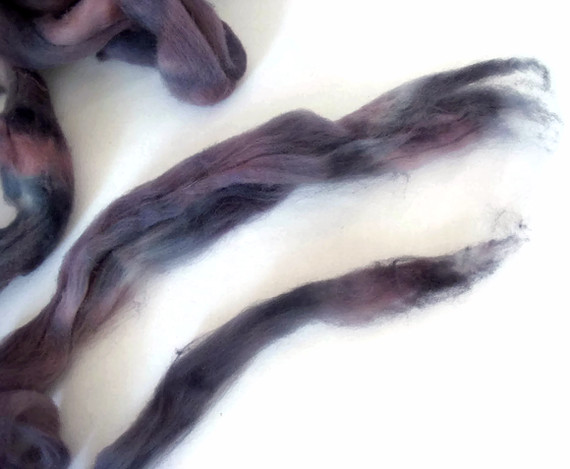
Look at the roving Z selected for me: Olympic Fiber Arts' Sunset on the Sound.


It’s so pretty, with its muted tones of pinks, greys, and smoky plums. It’s almost a neutral. I can only imagine how beautifully the colors would have blended together once spun. Alas, my assignment was to knit it. Zhenya thought this would make great knitting roving because the muted tones would remain more distinct if knit than if spun and because the colors already harmonize (which is a glorious product of the spinning in more clashingly colored rovings). Plus, it's a durable superwash wool that's next-to-the-skin soft.


If you’ve never knit with roving before, the idea of it is kind of scary -- a bit like the first time you cut into the steek on a cardigan you spent two years knitting. Set aside all those images of fiber just pulling apart like wisps in your hands; you needn’t worry.

Here’s how it works:

Start by unbraiding the roving.


Zhenya puts up the OFA roving using crochet-like chains, which makes them really easy to “un-zip” (carefully) from the bottom!

Next, separate the roving lengthwise (yes, that means the long, skinny-wise) into 4 or 5 thinner strips, each approximately the diameter of a No. 2 pencil. The roving pulls apart very easily.

This thinner roving is aptly named pencil roving because, ideally... well, you get it.

Now, if you’re an extreme perfectionist (like me), you might find yourself getting frustrated that you can’t get each length to be exactly the same diameter. Indulge your perfectionism for no more than a few seconds; then accept that, as usual, you’re over-thinking it. It will be fine if it’s close.

This is the pencil roving I made. It’s been separated, but nothing else has been done to it yet:


Once you’ve separated the roving into four or five thinner strips that are as close to the same diameter as possible, draft them a tiny bit to even everything out.

Drafting, which simply lengthens and straightens the individual fibers so they all lay nicely together in the same direction, is easy. Hold the fiber gently with your hands a few inches apart; slowly and carefully pull your hands ever so slightly further apart and watch as the fiber straightens itself out. Be careful: If you hold your hands too far apart, or pull too hard or too fast, you will separate the roving completely. When your plan is to spin the roving, that’s no big deal; but if your plan is to knit it, you really want to avoid this!

So how do you know how far apart to put your hands and how far is too far to pull? Staple length. Yes, it’s jargon, but this, too, is a cinch to figure out. Before you start drafting the roving, pinch a tiny tuft at the end and pull it away from the rest. You’ll notice that it came off in little strands of about the same length. That’s your magic distance! We'll call it "MD." It translates in practice like this:

Place your hands farther apart than MD (so the fiber will slip easily) but don’t pull the fiber as far apart as MD or the roving will separate.

Here you see my pencil roving has been drafted:


Here you see the difference between my pencil roving in its pre-drafted state (bottom) and as drafted (top):


How much should you predraft? That’s your call. I choose to err on the side of caution and leave the fiber thicker. It’s always possible to draft a bit more as you’re knitting, if necessary -- but it’s not possible to un-separate the fiber if you pulled it apart completely.

Once you’ve drafted all your fiber, you may want to check grist. It’s not necessary since you’ll swatch for gauge anyways, but if you’re curious (or, as some of us have already confessed, a compulsive perfectionist), it’s not such a bad thing to do. You’re aiming for the pencil roving to be about the same gauge as a bulky (12 ply) yarn -- about 5 or 6 wraps per inch.


I wrap roving tighter than I normally would with yarn because the fiber is so squishy and pulls just a hair thinner as I knit with it.

While you’re drafting (or knitting), you may come across slubs. Slubs are little bits where the fiber hasn’t fully aligned. They feel like bumps in the fiber. Here's one:


Slubs are not a big issue. I take care of them like this:


I pinch them out!

Once you've pre-drafted the fiber strips, gather them together for safe-keeping. I wind them into balls like this:


If you opt to do the same, please, please, please do not make the balls center-pull! Just imagine the disaster that would cause!

That’s all there is to prepping your fiber for knitting. And, really, that is the hardest part of knitting with roving.

Stay tuned for my next guest-blog entry, when I walk through steps for prepping your pattern and knitting a simple hat with all that lovely, pre-drafted roving!

If you’re dying to try this but don’t have any roving in your stash, why not give our hand-dyed Olympic Fiber Arts roving a try?


8.02.2008

(Not-So) Crabby

Yesterday I was crabby. Inexplicably so. Nothing was really wrong (except the Red Hawk Tailspin of Pacific Beach socks, which I finished but still can't quite bring myself to blog about... but that's been an ongoing saga). Nothing was really right (except that I sold the extra chicken coop and we got to take C to a free concert at Magnuson Park, where our favorite local band, Ockham's Razor, was playing). I was just mwlechghy, and the mwlechghiness made me crabby.

So when I woke up super early this morning, I went into C's room to cuddle her and said to myself, "No more crabbies today!" Then I remembered one Crab that would actually cheer me up: Crab Nebula!

4 oz of 100% handdyed Corriedale wool top

One of my blog friends, Gwen, sent it to me a couple weeks ago. Gwen's a brand-new college-graduate from Ohio... and I think that when I friended her months back, it was with an email that said little more than, "Hey, Ohio college student! I'm an Ohioan and was an Ohio college student, too." (I know—I was totally lame.) She blogs here, Ravels here, and has a wonderful little Etsy shop here. Gwen's fiber is lovely, and I had resisted for so long, but Crab Nebula called to me.

Here's Gwen's description of the fiber:
This is the first in my Hubble's Eye in Space series, inspired by images taken by the telescope. If you've never seen these amazing photos, check out hubblesite.org. The colors are spectacular! This has been handdyed in pink, yellow, turquoise, green.
Given that I know very little about astronomy, I had to look it up. Crab Nebula is the leftovers from a supernova explosion observed by the Chinese in 1054. It's in the Crab constellation, and it's cloud-like in appearance with what scientists believe to be high-energy particles still present.

I like the way Gwen thinks. I love the way Crab Nebula looks.

What a way to cure the crabbies! I'm going to keep this top around a little longer for my petting pleasure before spinning it.

BTW: Gwen's blog and Etsy shop are called Pieces of String Too Small To Save, and she's always interested in hearing from people about the creative things they do with theirs. Got bits of string? Tell Gwen about them here!

5.24.2008

Experimenting With Color

It's been killing me to have a drum carder and not be playing with it, but I vowed to wait until after I finished the stealth project. With that done, I could begin my new experiment, starting with this:


Unorthodox to card already beautiful, commercially prepared wool top, I know, but I wanted to play with color, and I didn't want to teach myself dyeing just yet. What you see is (L-R) 2 oz begonia, 1 oz blue ice, 3/4 oz khaki, and 1/4 oz peach.

My color selection was dictated largely by current stock at Weaving Works, which got cleaned out between the big Mother's Day sale and the LYS Tour.

The percentage breakdown, on the other hand, was sheer guesswork on my part.


The carding process itself isn't rocket science. You put the fiber on a tray and turn the handle, pulling the fiber under the "licker drum" (the small one) and distributing it onto the big drum. The machine does its thing. You add more fiber. Periodically you burnish the fiber on the carder, which smooths and compresses the fiber into the teeth so you can add more. And you wait to see what happens.


Okay, maybe you long-time fiber artists — or those of you who've been through MFA programs or color blending workshops — don't just wait and see because you already know how things will work together. Since I'm just figuring things out as I go, I wait and see! First batt off, and I'm liking what I see.


It's so darned cool! The next picture shows the first batt next to all the original roving. What a difference! How interesting! I'm hooked!


I originally intended to do the entire 4 oz at the exact same mix and had split down the top into four equal sections so I could do so. That's what you see in the batt above. But then I realized it would be much more interesting to experiment with gradations of the colors. So that's what I did.

I think the batts look like cotton candy!


The amounts of peach and ice blue stayed consistent throughout the four batts, but I varied the amounts of begonia and khaki in each. The top-left batt has no khaki and extra begonia. The bottom-right batt has half the normal amount of begonia and twice the normal amount of khaki.


Remarkable how much the colors get knocked down, no? Surprisingly tame. The picture above does a pretty good job showing the subtle color differences. What the pictures can't do, though, is show you how very, very fluffy and soft and wonderfully light these are!

As far as the spinning goes, I'm planning a 2-ply and will spin to keep the colors separated, tracking the gradation from the "khakier" one to the "begoniaier" one with maybe a little overlap at the transitions. Even though the color is perfect for my mom, I've promised this fiber to C. Once I see how much yardage I get, I'll decide for sure whether to make C a tank top or a skirt. We checked out some patterns on Ravelry this afternoon.

Before I could test-drive the drum carder (which works fantastically despite being nearly as old as me), I did need to pick up a couple other implements. Thanks to a recently arrived birthday check from J's aunt in Ohio, in combination with the 15% discount on total order card I got from Weaving Works on the LYS Tour, I was able to get a burnishing tool, a doffer stick, and a carder cleaning brush thing. You know the thing I mean... it's the flick-brush-type-tool with bent bristles that you use to clean fiber out of the carder fabric once the batt's been removed. I am now pretty well equipped for the carding process. Next time I'll try carding from locks!

4.25.2008

Have You Any Wool?

A few weeks ago, I mentioned the massive wool haul I scored at A New Yarn, but I hadn't gotten around to taking pictures yet. At long last, I can share with you the glory that is my MIL's early birthday present to me!

First up, the darker wool I've already posted pictures of in some spun-up skeins.


As you can see, the 5 ounces I spun barely made a dent in this >5-pound monster, which I had selected as my learn-to-spin practice fiber because... well... with such a luxury of fiber, I knew I wouldn't be hurting too much if I royally messed up a bunch of it.

There's a nice silver/grey in with all that dark brown. See?


It's really a joy to work with this wool. In perusing fiber at Weaving Works last week, I decided that it's probably Romney. I'm open to being wrong about that, though. It would help if I took samples of each of these fibers in for comparison's sake.

Up next, the pretty fawn-colored roving of unknown origin:

This weighs between 3 and 4 pounds. My scale stinks, so that's the closest weight I can get until I make my next trip to the post office.


It's the softest, smooshiest of the lot, and I love the color. I'm excited to work with it but plan to wait until my spinning gets a little more consistent. I'd love to make this into a sweater for myself. Even have an idea or two in mind!

Third up is this gorgeous white stuff:


It's between 1 and 2 pounds, and it's decided not to stay in any kind of neat, tidy formation like its darker cousins.


I really like looking at it...


...but I'm not sure what it will be like to spin...


...because it's not nearly as soft and squishy as it looks. In fact, it's the scratchiest of everything I've shown here. I don't have a clue what kind of fiber it is. Again, a sample taken to Weaving Works should clear up that question.

That was "the good." Now for "the ugly":


I say ugly only because the locks aren't all spiffed up into roving. There are some really pretty colorations here. Dark brown at the base (is that what you call it?) with redder tips. I don't have any cards or combs yet, so I'm not quite ready to tackle this project. Someday! It weighs about 2 pounds.

So there you have it: The most amazing, fortuitous fiber find I could possibly have imagined. Strike that... I couldn't have imagined it. We bought this fiber before I got my spinning wheel. In fact, it's what inspired me to "take a peek" at what was listed on Craigslist that lucky evening.

Yessiree, this fiber has already made a wonderful wonderful impact on my life—and I still get to spin it!